<?xml version="1.0" encoding="UTF-8"?>
<?xml-stylesheet type="text/xsl" href="/stylesheets/feed.atom.xml" media="screen"?>
<feed xml:lang="en-US" xmlns="http://www.w3.org/2005/Atom">
  <id>tag:newmatterlab.nd.edu,2005:/news</id>
  <link rel="alternate" type="text/html" href="https://newmatterlab.nd.edu"/>
  <link rel="self" type="application/atom+xml" href="https://newmatterlab.nd.edu/news.atom"/>
  <id>tag:newmatterlab.nd.edu,2005:/latest</id>
  <title>NewMATTER Design Lab | News</title>
  <updated>2026-07-28T11:09:00-04:00</updated>
  <link rel="alternate" type="text/html" href="https://newmatterlab.nd.edu/"/>
  <link rel="self" type="application/atom+xml" href="https://newmatterlab.nd.edu//news.atom"/>
  <subtitle>Our research is focused on improving the sustainability of designed objects through alternative service models, experimental biomaterials, and digital manufacturing.</subtitle>
  <entry>
    <id>tag:newmatterlab.nd.edu,2005:News/183644</id>
    <published>2026-07-28T11:09:00-04:00</published>
    <updated>2026-08-03T11:09:56-04:00</updated>
    <link rel="alternate" type="text/html" href="https://newmatterlab.nd.edu/news/idea-center-grants-support-commercialization-of-faculty-innovations-2026/"/>
    <title>IDEA Center grants to support commercialization of faculty innovations spanning natural materials, cancer drug delivery, and bio-particle production</title>
    <summary type="text">
      <![CDATA[The IDEA Center at the University of Notre Dame has announced the awardees of this year’s Research Commercialization Grants (RCGs). The…]]>
    </summary>
    <content type="html">
      <![CDATA[<p><a href="https://ideacenter.nd.edu/">The IDEA Center</a> at the University of Notre Dame has announced the awardees of this year’s <a href="https://ideacenter.nd.edu/news-events/events/2026/01/30/submission-deadline-research-commercialization-grant/">Research Commercialization Grants</a> (RCGs). The RCG is targeted, translational funding designed to accelerate the real-world impact of Notre Dame research by advancing the commercial readiness of the University’s most promising research inventions.</p>
<p>Supported by gifts from the IDEA Center’s Advisory Council, other donors, and funding from the University, the RCG enables researchers to work with industry experts to define and achieve commercially relevant, market-driven milestones that advance their technologies toward real-world impact.</p>
<p>“The innovations pitched by our faculty members this year showcase the depth of talent and translational vision across Notre Dame's research community,” said <a href="https://research.nd.edu/people/karen-deak/">Karen Deak</a>, executive director of the IDEA Center. “By bridging the gap between breakthroughs and market readiness, these grants allow us to accelerate technologies that address some of the world's most pressing challenges and support our researchers as they embody the University's mission to be a powerful means for doing good in the world.”</p>
<p>The faculty inventions selected for RCG support in this cycle span sustainable materials, cancer therapeutics, and biological nanoparticle manufacturing.</p>
<h2>Manufacturing natural, fiber-based materials</h2>
<p><a href="https://artdept.nd.edu/people/jason-carley/">Jason Carley</a>, assistant professor of industrial design in the <a href="https://artdept.nd.edu/">Department of Art, Art History, and Design</a>, has developed a sustainable biocomposite material designed to replace medium density fiberboard (MDF), an engineered wood product that is widely used in residential construction. Carley’s material is made up of recycled cellulose and soy-based adhesives, in contrast with MDF’s composition of virgin timber and formaldehyde-based adhesives, and has proven comparable to MDF in early performance assessments. The RCG will support scaled development and more rigorous mechanical testing of Carley’s novel material, positioning it as a lightweight, commercially viable, domestically sourced alternative that could reduce dependence on imported materials across furniture, cabinetry, RV, and interior panel markets.</p>
<h2>Reviving shelved cancer drugs</h2>
<p>Many promising cancer drug candidates never reach patients because they damage healthy tissue at the high doses required to eliminate tumors. To address this challenge,<a href="https://research.nd.edu/people/prakash-nallathamby/"> Prakash Nallathamby</a>, associate director of the<a href="https://precisionhealth.nd.edu/"> Berthiaume Institute for Precision Health</a>, and <a href="https://bioengineering.nd.edu/people/aurelie-moutran/">Aurelie Brownsberger</a>, a doctoral student in the <a href="https://bioengineering.nd.edu/">Bioengineering Graduate Program</a>, have invented a magnetoelectric nanoparticle platform designed to selectively deliver these drugs to cancerous tissue.</p>
<p>The delivery platform, called MagSiNs, chemically binds a drug to a nanoparticle that preferentially accumulates in tumor tissue by taking advantage of magnetoelectric differences between healthy and tumor tissue. Once embedded, the release of the drug is triggered by a brief electromagnetic pulse. The RCG will support the integration of MagSiNs with potent anticancer drug candidates developed by<a href="https://chemistry.nd.edu/people/herman-sintim/"> Herman Sintim</a>, the Grace-Rupley Professor of <a href="https://chemistry.nd.edu/">Chemical Biology</a> and associate director of the<a href="https://harpercancer.nd.edu/"> Harper Cancer Research Institute</a>, to target an aggressive, high-mortality subtype of colorectal cancer. It will also support the generation of preclinical efficacy and safety data in colorectal cancer models, potentially enabling the renewed development of cancer therapies previously limited by toxicity.</p>
<h2>Scaling production of novel drug delivery agents</h2>
<p>Extracellular vesicles (EVs) — naturally occurring, lipid nanoparticles released by virtually all cells to communicate and transport cargo — are an emerging class of therapeutic and drug delivery agents. Current manufacturing approaches, however, are limited by low yield and limited scalability.</p>
<p>To address these limitations, <a href="https://engineering.nd.edu/faculty/yichun-wang/">Yichun Wang</a>, the Keating-Crawford Collegiate Professor of <a href="https://cbe.nd.edu/">Biomolecular Engineering</a>, has developed an EV fabrication platform that increases particle production in cell cultures by up to eight-thousand percent. The platform, which mimics the natural tissues that produce EVs, is a mesh-like web of fibers that generates electricity when bent or stretched. The RCG will accelerate the pilot, optimization, and de-risking of a one-liter reactor for research-grade EV production, with the long term potential to enable cost-effective EV fabrication across the growing sector.</p>
<p>Learn more about research commercialization at Notre Dame by visiting the <a href="https://ideacenter.nd.edu/">IDEA Center</a> website. To learn more about the Research Commercialization Grants program, contact <a href="mailto:bsheyko@nd.edu">Benjamin Sheyko</a>, Technology Development Program Manager.</p>
<p><strong>Contact</strong></p>
<p>Erin Fennessy Lawlor / Writing Program Manager</p>
<p>Notre Dame Research / University of Notre Dame</p>
<p><a href="mailto:erin.lawlor@nd.edu">erin.lawlor@nd.edu</a> / +1 574-631-8183</p>
<p><a href="http://research.nd.edu">research.nd.edu</a> / <a href="http://linkedin.com/company/undresearch">linkedin.com/company/undresearch</a></p>
<p><strong>About Notre Dame Research</strong></p>
<p>The University of Notre Dame is a leading global Catholic research university located in South Bend, Indiana (USA). Inspired by its Catholic mission and founder Rev. Edward Sorin, C.S.C.’s vision for the University to be “one of the most powerful means for doing good” in the world, Notre Dame’s faculty and students pursue globally significant research, scholarship, and creative endeavor that advances discovery, fosters innovation, and drives lasting positive impact. For more information, please visit <a href="http://research.nd.edu">NDR's website</a> or <a href="https://www.linkedin.com/company/undresearch/">NDR's LinkedIn</a>. To learn more about the innovation unfolding at the University of Notre Dame, <a href="https://nd.portals.in-part.com/">browse available intellectual property</a>. To discuss licensing opportunities, contact Tim Joyce at tjoyce2@nd.edu.</p>
<p class="attribution">Originally published by <span class="rel-author">Erin Fennessy Lawlor</span> at <span class="rel-source"><a href="https://ideacenter.nd.edu/news-events/news/idea-center-grants-support-commercialization-of-faculty-innovations-2026/">ideacenter.nd.edu</a></span> on <span class="rel-pubdate">July 23, 2026</span>.</p>]]>
    </content>
    <link rel="enclosure" type="image/jpeg" href="https://newmatterlab.nd.edu/assets/669153/ndr_0426_mccloskey_rcg_pitch_event_15sm.jpg" title="Jason Carley speaks at the IDEA Center Notre Dame pitch event presenting on sustainable materials"/>
    <author>
      <name>Erin Fennessy Lawlor</name>
    </author>
  </entry>
  <entry>
    <id>tag:newmatterlab.nd.edu,2005:News/174604</id>
    <published>2025-08-28T16:29:00-04:00</published>
    <updated>2025-08-28T16:29:46-04:00</updated>
    <link rel="alternate" type="text/html" href="https://newmatterlab.nd.edu/news/collecting-more-than-trash-researchers-equip-local-garbage-trucks-to-gather-data-on-urban-heat-island-effect/"/>
    <title>Collecting more than trash: Researchers equip local garbage trucks to gather data on urban heat island effect</title>
    <summary type="text">
      <![CDATA[To help identify — and ultimately mitigate — heat islands in South Bend, a team of University of Notre Dame researchers has partnered with the city to collect data using a novel method: garbage trucks. Ming Hu, the associate dean for research, scholarship and creative work in Notre Dame’s School of Architecture; Jason Carley, an assistant professor of industrial design; and Siavash Ghorbany, a doctoral student in civil and environmental engineering, have designed and deployed sensors on the city’s fleet of garbage trucks that can continuously monitor and record data on temperature and humidity as the trucks complete their normal routes.]]>
    </summary>
    <content type="html">
      <![CDATA[<figure class="image image-right"><img src="https://news.nd.edu/assets/627795/ghorbany_sb.jpg" alt="A person with long dark hair pulled back installs a gray device under a large truck using a screwdriver." width="600" height="400">
<figcaption>Siavash Ghorbany, a doctoral student in civil and environmental engineering, installs a sensor on a City of South Bend garbage truck. Photo provided.</figcaption>
</figure>
<p>When heat waves hit, they don’t hit evenly. Cities often experience significantly higher temperatures than nearby rural areas, and areas with more pavement and concrete and fewer trees are more severely impacted.</p>
<p>These urban heat islands, which disproportionately affect lower-income neighborhoods, <a href="https://www.epa.gov/green-infrastructure/reduce-heat-islands">increase air pollution and energy costs, as well as heat-related illnesses and deaths</a>.</p>
<p>To help identify — and ultimately mitigate — heat islands in South Bend, a team of University of Notre Dame researchers has partnered with the city to collect data using a novel method: garbage trucks.</p>
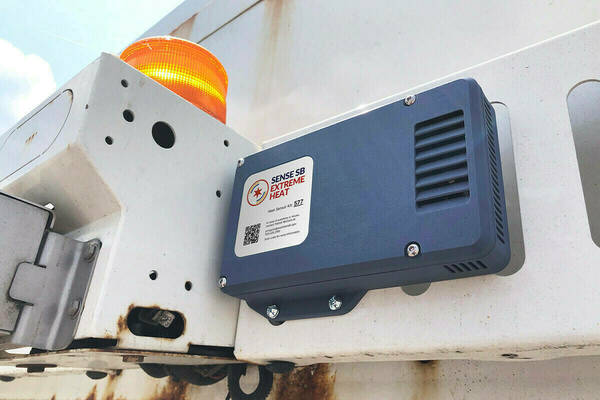
<p><a href="https://architecture.nd.edu/about/directory/ming-hu/">Ming Hu</a>, the associate dean for research, scholarship and creative work in Notre Dame’s School of Architecture; <a href="https://artdept.nd.edu/people/jason-carley/">Jason Carley</a>, an assistant professor of industrial design; and <a href="https://lucyinstitute.nd.edu/people/graduate-scholars/2024-2026-lucy-graduate-scholars-cohort/siavash-ghorbany/">Siavash Ghorbany</a>, a doctoral student in civil and environmental engineering, have designed and deployed sensors on the city’s fleet of garbage trucks that can continuously monitor and record data on temperature and humidity as the trucks complete their normal routes.</p>
<p>The use of garbage trucks as mobile weather research stations offers some distinct advantages and challenges, Carley said. Because garbage trucks run the same route every week, they allow the researchers to gather consistent, detailed data in neighborhoods throughout the city.</p>
<p>“The more challenging part of the study is that you have to have this advanced technology out in the elements, in the rain, on a moving truck,” he said. “So, some of it has to be waterproofed, but the rest of it needs to have access to ambient air and be protected from direct sunlight.”</p>
<p>Carley, who designed custom housing for the sensors, also needed to ensure the housing was secure, was customized to different types of trucks in the fleet, and would allow for accurate temperature data without interference from the garbage truck itself. After he finalized his design this summer, the sensors were deployed at the beginning of August.</p>
<p>The collaboration between the University and the city began in 2023, Hu said, with discussions on how to use emerging sensor technologies to better understand a range of environmental stressors facing the city, including urban heat island effects and air quality.</p>
<p>“The data collected, along with the resulting analytical tools, will support the city in allocating both financial and physical resources — like tree planting — and in planning for greater resilience as extreme weather conditions intensify,” Hu said.</p>
<p>Identifying heat islands within the city is especially important, Carley noted, because extreme heat is most likely to impact vulnerable populations, including lower-income families and the elderly.</p>
<figure class="image image-left"><img src="https://al.nd.edu/assets/627803/sb_sensor.jpg" alt='A gray SENSE SB Extreme Heat sensor, labeled "Heat Sensor Kit: 572", mounted on a white garbage truck next to an amber warning light.' width="600" height="400"></figure>
<p>“Air conditioning is expensive and energy intensive, so it may not be something lower-income residents have as much access to,” Carley said. “When you have hot temperatures outside and inside the home, it becomes a public health issue. Adding green spaces and trees is important not just for recreation or aesthetics, but to protect the health of residents.”</p>
<p>The research builds on work that Hu and Ghorbany completed at Notre Dame last year <a href="https://www.mdpi.com/2075-5309/14/9/2751">to determine where heat islands might exist on campus</a>. As they collected data, Ghorbany developed a model, fine-tuned for the Notre Dame campus, that uses satellite imagery to measure building density, materials, and vegetation coverage through segmentation and computer vision techniques. He then used machine learning to identify areas with the highest potential for experiencing a heat island effect.</p>
<p>“This project allows us to test our model on a larger scale, in the city of South Bend,” Ghorbany said. “If it works as we expect it to, we can eventually move to using the model to predict these effects, instead of logging data each time, which is close to impossible for larger cities. By quickly identifying these areas, we can help cities focus their efforts on reducing the temperature by increasing the tree canopy or implementing building renovations.”</p>
<p>The sensors will remain in place during August and September, after which Ghorbany and Hu will analyze the data. Once the analysis is complete, the team will present its findings to the City of South Bend’s Office of Sustainability and share them with South Bend residents.</p>
<p>The researchers also hope to expand the project in future phases to measure air quality and other markers of public health.</p>
<p>“Our work consistently shows that the built environment is not just a physical setting, but a determinant of health,” Hu said. “By linking fine-grained environmental data with building and neighborhood characteristics, we can reveal where risks are concentrated and how design or policy interventions can reduce them. Projects like this one in South Bend demonstrate how data collection at the street level can ultimately guide healthier, more resilient cities nationwide.”</p>
<p><em><strong>Contact: </strong>Carrie Gates, associate director of media relations, 574-993-9220, <a href="mailto:c.gates@nd.edu">c.gates@nd.edu</a></em></p>
<p class="attribution">Originally published by <span class="rel-author">Carrie Gates</span> at <span class="rel-source"><a href="https://news.nd.edu/news/collecting-more-than-trash-researchers-equip-local-garbage-trucks-to-gather-data-on-urban-heat-island-effect/">news.nd.edu</a></span> on <span class="rel-pubdate">August 28, 2025</span>.</p>]]>
    </content>
    <link rel="enclosure" type="image/jpeg" href="https://newmatterlab.nd.edu/assets/627852/sb_sensor.jpg" title="A gray SENSE SB Extreme Heat sensor, labeled &quot;Heat Sensor Kit: 572&quot;, mounted on a white garbage truck next to an amber warning light."/>
    <author>
      <name>Carrie Gates</name>
    </author>
  </entry>
  <entry>
    <id>tag:newmatterlab.nd.edu,2005:News/169390</id>
    <published>2024-11-10T13:44:00-05:00</published>
    <updated>2025-06-12T10:39:02-04:00</updated>
    <link rel="alternate" type="text/html" href="https://newmatterlab.nd.edu/news/building-connections-rclc-students-design-birdhouses-for-habitat-families/"/>
    <title>Building connections: NewMATTER faculty and RCLC students design birdhouses for Habitat families</title>
    <summary type="text">
      <![CDATA[A collaboration between the Robinson Community Learning Center (RCLC) and the University of Notre Dame’s Art, Art History, and Design Department is equipping local students with valuable technical skills while contributing to…]]>
    </summary>
    <content type="html">
      <![CDATA[<p>A collaboration between the <a href="https://rclc.nd.edu/">Robinson Community Learning Center</a> (RCLC) and the University of <a href="https://artdept.nd.edu/">Notre Dame’s Art, Art History, and Design Department</a> is equipping local students with valuable technical skills while contributing to a meaningful community engagement project.</p>
<p>As part of this effort, RCLC students have taken on a unique project: researching, planning, and building birdhouses to be gifted to families moving into Habitat for Humanity homes in South Bend’s Near Northwest Neighborhood. The theme of the project is “what makes a house a home?”</p>
<p>This initiative was inspired by <a href="https://publicaffairs.nd.edu/news/inaugurationbuild2024/">Inauguration Build 2024</a>, a five-day event in September that honored the Inauguration of Notre Dame’s 18th president, Rev. Robert A. Dowd, C.S.C. During the build, nearly 750 University faculty and staff came together to construct five affordable homes on Harrison Avenue.</p>
<p>RCLC Director Susan Devetski recalls the students’ curiosity about the massive project happening in their community.</p>
<p>“Our students are curious about everything,” she said. “While we couldn’t participate directly in building houses, we wanted to provide them with a meaningful experience. We thought a birdhouse would be a perfect way to introduce the ideas of shelter, community, and doing for others.”</p>
<p>The birdhouse, which will be presented to Habitat families as gifts in the spring, was a collaboration between Devetski and Jason Carley, assistant professor in Notre Dame’s Design Department. Together, they created the project which merged technical learning with community service. They decided on the birdhouse idea as it symbolizes the need for shelter and housing.</p>
<p>“The RCLC students learned about technical drawings and construction techniques, starting with research on bird habitats, and brainstorming what features an ideal birdhouse might have,” Carley says.</p>
<p>Students first created 2D sketches of their birdhouse designs, which were then transformed into wooden templates in the West Lake Makerspace on campus. Carley returned with the pre-cut materials for assembly, and the students eagerly put their creations together.</p>
<p>“It was important for them to physically build something they designed and to understand the fluidity of the design process” Carley adds. “They had a blast going through the assembly steps and piecing together the kits like puzzles, using tools like rulers, clamps, and screwdrivers.”</p>
<p>Devetski was struck by how deeply the students were engaged with the project.</p>
<p>“They were so hands-on, and it gave them a sense of accomplishment. It’s one thing to talk about engineering and design concepts, but it’s entirely different to build something with your own hands,” she says.</p>
<p>As the final phase of the project, students will paint their birdhouse in bright colors to protect them from the elements. Once completed, it will be distributed to families moving into Habitat homes, adding a special touch of welcome to their new beginnings.</p>
<p>“This project goes beyond building a birdhouse,” Devetski reflects. “It’s about teaching our students to give back and create something meaningful for others.”</p>
<p>The collaborative project was funded by a grant from Americorps.</p>
<p><script src="https://newmatterlab.nd.edu/javascripts/lb.js?v=2023-05-17" defer></script><ul id="gallery-683" class="gallery-lb gallery-683" data-count="7"><li><a href="https://publicaffairs.nd.edu/assets/592708/fullsize/mc_92724_rclc_birdhouses_10_1_jpg.jpg" title="Students in the Robinson Community Learning Center's after school program assembled birdhouses for the homes on Harrison St. in South Bend" data-title="Students in the Robinson Community Learning Center&#39;s after school program assembled birdhouses for the homes on Harrison St. in South Bend"><img src="https://publicaffairs.nd.edu/assets/592708/300x300/mc_92724_rclc_birdhouses_10_1_jpg.jpg" alt="Students in the Robinson Community Learning Center&#39;s after school program assembled birdhouses for the homes on Harrison St. in South Bend" width="300" height="300" loading="lazy"></a></li><li><a href="https://publicaffairs.nd.edu/assets/592711/fullsize/mc_92724_rclc_birdhouses_03jpg.jpg" title="RCLC's Susan J. Devetski works with after school program student Tylisa Brelsford. Students in the Center's after school program assembled birdhouses for the homes on Harrison St. in South Bend" data-title="RCLC&#39;s Susan J. Devetski works with after school program student Tylisa Brelsford. Students in the Center&#39;s after school program assembled birdhouses for the homes on Harrison St. in South Bend"><img src="https://publicaffairs.nd.edu/assets/592711/300x300/mc_92724_rclc_birdhouses_03jpg.jpg" alt="RCLC&#39;s Susan J. Devetski works with after school program student Tylisa Brelsford. Students in the Center&#39;s after school program assembled birdhouses for the homes on Harrison St. in South Bend" width="300" height="300" loading="lazy"></a></li><li><a href="https://publicaffairs.nd.edu/assets/592710/fullsize/mc_92724_rclc_birdhouses_02jpg.jpg" title="The finished birdhouse" data-title="The finished birdhouse"><img src="https://publicaffairs.nd.edu/assets/592710/300x300/mc_92724_rclc_birdhouses_02jpg.jpg" alt="The finished birdhouse" width="300" height="300" loading="lazy"></a></li><li><a href="https://publicaffairs.nd.edu/assets/592712/fullsize/mc_92724_rclc_birdhouses_04jpg.jpg" title="Zayra Montoya tries to hold the pieces tightly together as the glue sets" data-title="Zayra Montoya tries to hold the pieces tightly together as the glue sets"><img src="https://publicaffairs.nd.edu/assets/592712/300x300/mc_92724_rclc_birdhouses_04jpg.jpg" alt="Zayra Montoya tries to hold the pieces tightly together as the glue sets" width="300" height="300" loading="lazy"></a></li><li><a href="https://publicaffairs.nd.edu/assets/592714/fullsize/mc_92724_rclc_birdhouses_07jpg.jpg" title="Jason Carley instructs RCLC after school program students on how to build the birdhouses" data-title="Jason Carley instructs RCLC after school program students on how to build the birdhouses"><img src="https://publicaffairs.nd.edu/assets/592714/300x300/mc_92724_rclc_birdhouses_07jpg.jpg" alt="Jason Carley instructs RCLC after school program students on how to build the birdhouses" width="300" height="300" loading="lazy"></a></li><li><a href="https://publicaffairs.nd.edu/assets/592716/fullsize/mc_92724_rclc_birdhouses_09jpg.jpg" title="RCLC after school program student Tylisa Brelsford works on her birdhouse" data-title="RCLC after school program student Tylisa Brelsford works on her birdhouse"><img src="https://publicaffairs.nd.edu/assets/592716/300x300/mc_92724_rclc_birdhouses_09jpg.jpg" alt="RCLC after school program student Tylisa Brelsford works on her birdhouse" width="300" height="300" loading="lazy"></a></li><li><a href="https://publicaffairs.nd.edu/assets/592709/fullsize/mc_92724_rclc_birdhouses_01jpg.jpg" title="The birdhouse template pre-cut " data-title="The birdhouse template pre-cut "><img src="https://publicaffairs.nd.edu/assets/592709/300x300/mc_92724_rclc_birdhouses_01jpg.jpg" alt="The birdhouse template pre-cut" width="300" height="300" loading="lazy"></a></li></ul><script>document.addEventListener("DOMContentLoaded", function(){var lightbox = new Lightbox({showCaptions: true,elements: document.querySelector(".gallery-683").querySelectorAll("a")});});</script></p>
<p> </p>
<p class="attribution">Originally published by <span class="rel-author">Colleen Wilcox</span> at <span class="rel-source"><a href="https://publicaffairs.nd.edu/news/building-connections-rclc-students-design-birdhouses-for-habitat-families/">publicaffairs.nd.edu</a></span> on <span class="rel-pubdate">November 07, 2024</span>.</p>]]>
    </content>
    <link rel="enclosure" type="image/jpeg" href="https://newmatterlab.nd.edu/assets/601505/mc_92724_rclc_birdhouses_05jpg.jpg" title="Jason Carley is the Assistant Professor of Art, Art History, and Design at Notre Dame"/>
    <author>
      <name>Colleen Wilcox</name>
    </author>
  </entry>
</feed>